 | Where there's muck there's brass as the saying goes, and as world leader in textile production England was enjoying unparalleled wealth and trade. | ||||||
| So whilst England raked in the coffers and revelled in the 'brass', factory workers in cramped, filthy housing and often dangerous working conditions, were firmly on the receiving end of the muck! The rapid growth of the cotton industry demanded an ever increasing work force. Workers moved out of the country and into the city attracted by the prospect of better paid jobs in textile production. City slums And an ever growing work force demanded ever growing accommodation.
Open sewers and shared privies meant disease was rife and in 1831, Manchester was hit by a severe cholera epidemic which claimed hundreds of lives. Whilst living conditions remained a cause of serious concern, the occupational health risks of factory work soon became apparent to the medical profession. 'A fair day's pay for a fair day's labour!'
Long working days continued throughout the 18th Century and for much of the 19th too. Mechanisation may have shifted cotton spinning from a craft to an industrial process, but it came at a cost - a human cost. The noise from machinery was deafening, many workers became skilled lip readers in order to communicate over the noise. Ear protection was not compulsory leading to many workers becoming deaf. Fighting for breath The air in the cotton mills had to be kept hot and humid (65 to 80 degrees) to prevent the thread breaking.
The air in the mill was thick with cotton dust which could lead to byssinosis - a lung disease. Although protective masks were introduced after the war, few workers wore them as they were made uncomfortable in the stifling conditions. Eye inflammation, deafness, tuberculosis, cancer of the mouth and of the groin (mule-spinners cancer) could also be attributed to the working conditions in the mills. Long hours, difficult working conditions and moving machinery proved a dangerous combination. Accidents were common and could range from the loss of a finger to fatality. | |||||||
Wednesday, 18 April 2012
Working conditions of the Mills
After the group tutorial I started looking into diseases and living conditions of when the cottons mills were at their worst, and the interactions betweens people which will show just how fast the diseases spread. I came across this article which briefly gives an outline of how the population rapily grew.


Thursday, 12 April 2012
global threads- whitworth
I think that this is an exhibition we should all visit together. The work on display discuses cotton as a commodity that has had a vast impact on the trade between different countries. Making me think about the positive and negative outcomes brought about by the cotton industry. The sculpture below by Yinka Shonibre blurs the boundaries of what we may perceive to be specific to a particular culture. For example hear is a quote from the leaflet I picked up at the exhibition discussing the very same work " Why are his formal clothes made of what looks like 'african' cloth?......The boys identity is ambiguous as the cloth on his back, which is known as 'dutch wax' because it was first produced in the
I did some drawing at the exhibition (below) two dresses from different times, one from the 40's and one from the late 18th century. The vast difference in style shows how man manipulates nature in this case cotton to suite what is in demand at that particular time.


Wednesday, 11 April 2012
Lost City Of Manchester
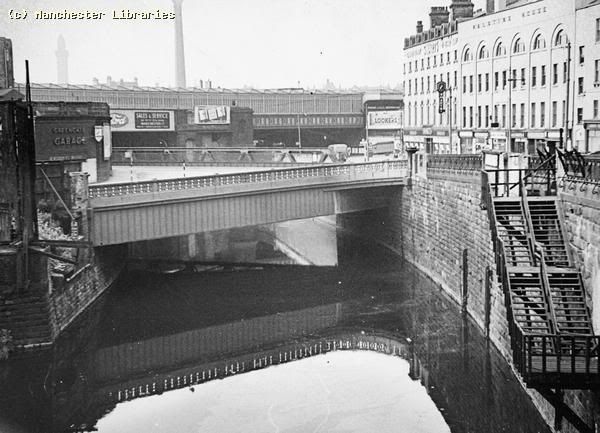
Below is a link to a blog which has some inforamtion about the hidden Manchester. Some images from the Blog of Manchester
http://www.myspace.com/phill.d/blog/430373437


Heat reactive paint
Hey guys something interesting that I have found ------>
This is done by Heat reactive paint. When the room temperature is high the heat reactive paint takes effect and when the room is cooler then the paint will disappear. This method could be good to use to show layers.
Something that we could consider to use for the project.
The colour changing and heat sensitive title really drew my attention. I came across an article about how the temperature of the room can change the colour of objects or even the wall paper colour in the same room. I was fascinated by this and wanted to know how it was done. After some further research I finally found how it is done. To get the colour changing and heat sensitive effect a heat reactive paint is needed.
I really like this technique because there is a layer but also an invisible layer to. This is another perfect technique that can be applied to Unit X. Since I am looking at industrial revaluation, this technique can be applied to show the Current Manchester then with the heat reactive paint the old Manchester with the mills can be shown


This is done by Heat reactive paint. When the room temperature is high the heat reactive paint takes effect and when the room is cooler then the paint will disappear. This method could be good to use to show layers.
Something that we could consider to use for the project.
The colour changing and heat sensitive title really drew my attention. I came across an article about how the temperature of the room can change the colour of objects or even the wall paper colour in the same room. I was fascinated by this and wanted to know how it was done. After some further research I finally found how it is done. To get the colour changing and heat sensitive effect a heat reactive paint is needed.
I really like this technique because there is a layer but also an invisible layer to. This is another perfect technique that can be applied to Unit X. Since I am looking at industrial revaluation, this technique can be applied to show the Current Manchester then with the heat reactive paint the old Manchester with the mills can be shown


Thursday, 5 April 2012

Wednesday, 21 March 2012
Three Little Pigs TV Advert by The Guardian
Hi all in group 1!
Loving the new advert by The Guardian, really inspirational for all those who are thinking of using video to present ideas!
Loving the new advert by The Guardian, really inspirational for all those who are thinking of using video to present ideas!
Maps of Manchester
During the mind-mapping session last week, we discussed with Alex Russel about looking at Manchester BEFORE the Industrial Revolution, in an effort to use material from the past to create future ideas. Here's a website which shows maps of the Manchester area before, during and after the Revolution!: http://manchester.publicprofiler.org/beta/index.php

Subscribe to:
Posts (Atom)